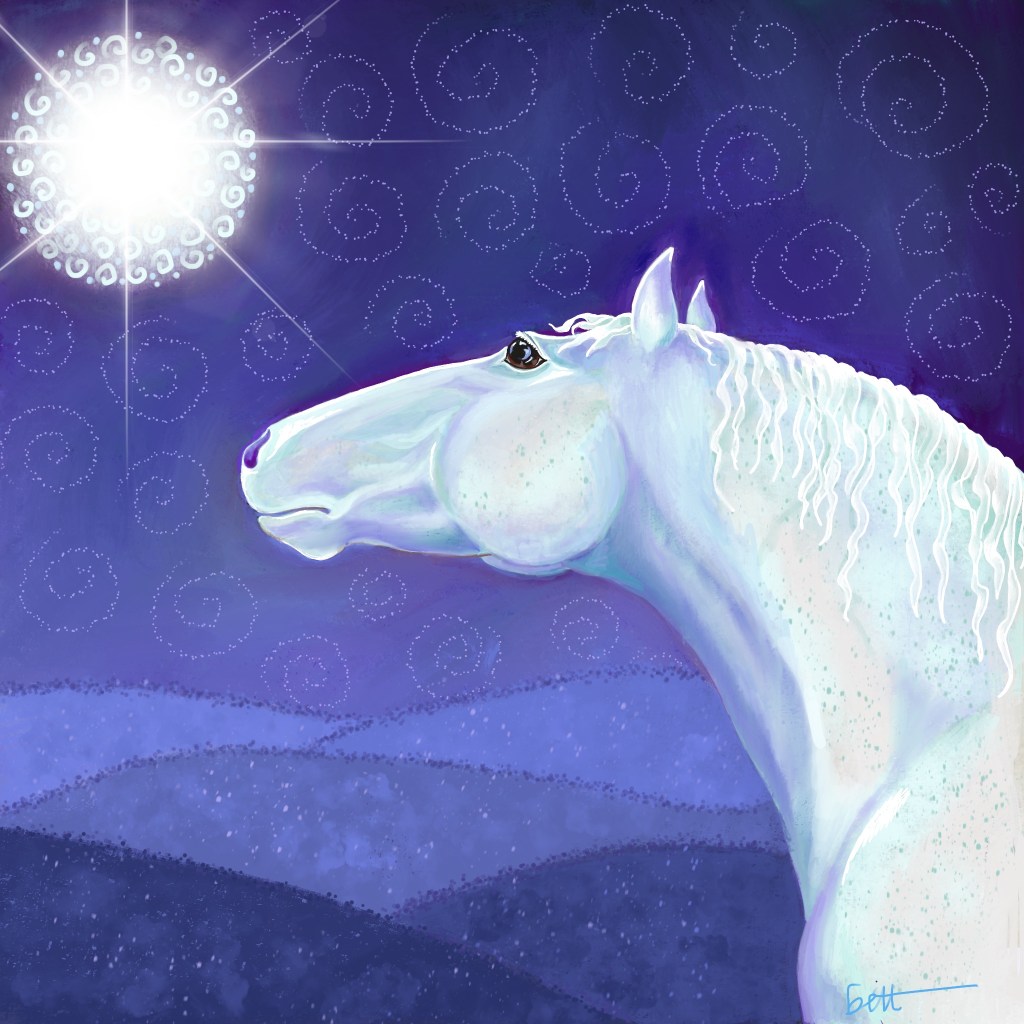
This shortest day, as promise wakens in the sleeping land
From The Shortest Day, by Susan Cooper
Betty Dalke Wathne
December 2020
Freezing rain and sleet tinkled against the day’s accumulation of ice. It was the winter solstice, the longest night of the year. The ground was roughly rutted, a little frozen on top but with deep sucking mud underneath, and the footing was tricky. I wanted to look up to see the Bethlehem Star – the great conjunction of Jupiter and Saturn. I wanted to get Spider into his stall where soft shavings, a fresh bucket of water, and a meal awaited him. But I also really wanted to see those converged planets, forming the appearance of one large star, the Christmas Star. Perhaps it would make Christmas seem more real in a year when loved ones are hurting, are far away, are ill, and we are all separated for safety.
Spider was eager to get inside, shivering a little under his ice-spangled blanket, his thick winter coat standing in wet peaks, looking forward to his hay and bite of grain. There could be grated carrots or a slice of apple, too. That’s something a horse can really look forward to. He wanted to rush to the stable and its comfort. But he is attuned to my movement, and when I stopped to look up, he stopped too. I had spent a lot of time over the years training him to lead perfectly – moving forward, speeding up, slowing down, stopping, backing – just in response to the way I moved, and he never pulled ahead. But last winter I could not walk him in from the barn. My knee was bad, my balance was bad, I had a chronic achilles injury, and I could not handle the ruts, the mud, the ice, or any of it, really. So I held on to my horse. His four sound legs were steadier than my two damaged legs. And my old gelding, who had learned for decades to never walk ahead, now learned to walk with me aligned by his shoulder, one hand on him for support. He learned to take small, careful strides, making sure I was right next to him and secure in my balance before each new step.
On this longest night, even though this year I could easily navigate rutted, muddy, slick ground in the dark, with my new knee and healed ankle and stronger legs, I still walked next to his shoulder, one hand under his mane on that warm freckled neck. It had become our habit – symbolic mutual comfort and support. Sometimes we just walk that way now. He felt me stop to look up, at the Christmas star, the waxing moon, the deep blue sky with bright drifting clouds. And he waited for me. He flung his head up and gazed upwards as well.
The two of us were quiet in the tinkling night. I pondered the winter sky, the change in my ability to walk this year, Christmas week arriving, my intentions of being alone on the holiday, loved ones near and far. I don’t know what Spider was pondering. I could hear him breathe. He could hear me breathe. We didn’t need to share thoughts to know that we were together, there for each other.
Lipizzans traditionally have one rider for their entire lives. Over the centuries of careful breeding, they have, perhaps more than other horse breeds, developed the ability to bond closely with one person. Their breeding has been so carefully aligned with classical correctness rather than show ring fashions, that they are famous and well-respected despite being old-fashioned. The Lipizzan does not have abundant flowing hair or extravagant movement as in fancier breeds. But there is a classical beauty to their short stature, round barrel, and arched neck, resembling a warhorse carved on a Greek frieze. Spider has descended from this royal lineage. He is an elegant warhorse in his own way, an everyday sort of hero. He is Maestoso Melora, and his super power is loyal devotion.
So Spider stood in all his noble serenity and power under my hand, and the two of us were part of that illuminated night together. Then I thought about continuing on, and he felt my intention, and we moved on into the barn. It was the Winter Solstice, the longest night, and the days were going to get longer.
 Meadowsweet